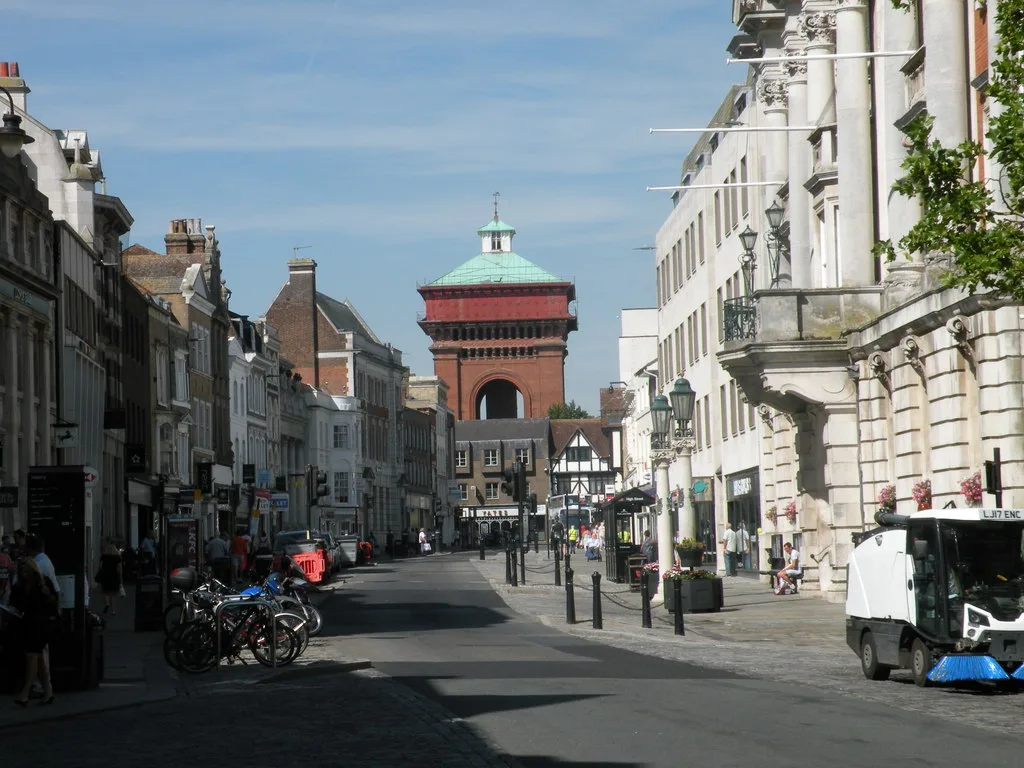

A motion at Cabinet on 2 September asks Colchester to use rental auctions on units empty a year, and to publish a new high street strategy within six months.
Update, 14 September 2026. Cabinet rejected the motion on 2 September. Separately, the government has since withdrawn the decision to abolish Colchester City Council, so the May 2027 shadow elections and the 1 April 2028 vesting day set out below, and in the timeline graphic, no longer stand. They are left here as the timetable the council was working to when this article was published.
Colchester City Council’s Cabinet meets on Wednesday 2 September to consider a motion arguing that city status has not delivered for the high street, and asking the council to start auctioning off leases on long-empty shops. (Cabinet agenda, 2 September 2026)
The motion, “Delivering on the Promise of City Status”, was proposed by Councillor Lee Scordis, leader of the council’s Labour group, and seconded by Councillor Julie Young. It was put to Full Council on 22 July, but because it concerns an executive function and procedure rule 11(2) was not suspended, Full Council never debated it. It went straight to Cabinet instead. (Item 8(ii), Council Motion)
What the motion asks for
The motion notes that Colchester was granted city status in 2022 in the Queen’s Platinum Jubilee Honours, and that this was promoted as a way to raise the city’s profile, attract investment, boost tourism and create jobs. It then says that “many residents and local businesses perceive a lack of visible progress in improving the retail offer”, listing:
- persistent vacant units
- a limited and declining retail mix
- insufficient support for independent businesses
- a lack of cohesive vision for the high street experience
It also makes the point that city status “does not automatically deliver funding or powers”.
The motion asks the council to:
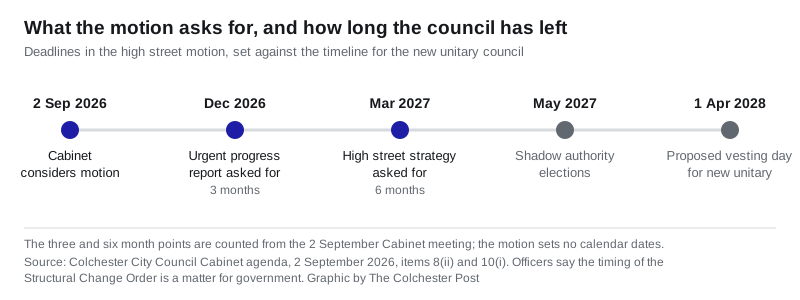
- publish a refreshed City Centre and High Street Strategy within six months, covering the retail mix, vacancy reduction, support for independent and start-up businesses and the evening and visitor economy
- establish a City Status Delivery Plan measured on footfall, occupancy rates, local employment and tourism
- take advantage of the government’s High Street Rental Auction programme to tackle vacant units
- enforce the city centre PSPO against anti-social behaviour
- report publicly on progress at least once a year
- bring forward an urgent progress report in three months identifying gaps in delivery
What a high street rental auction actually is
This is a real power, not an aspiration, and it is worth knowing what it can and cannot do.
The power came into force on 2 December 2024. It lets a council in England put the lease of a persistently vacant high street unit out to auction, and grant a lease of between one and five years, without the landlord’s agreement. (MHCLG, 2 December 2024)
A unit only qualifies if it meets the vacancy condition: unoccupied continuously for 365 days, or for at least 366 days within a 24-month period. Before going to auction, the council must first try to resolve the vacancy by engaging with the landlord, and it has to designate the high street areas the power applies to. (MHCLG non-statutory guidance)
So this is not a quick fix for a shop that shut last month. It is aimed squarely at units a landlord has left empty for over a year.
The council’s answer so far
The council issued a statement ahead of the meeting setting out what is already happening, rather than responding to the motion point by point. It cites more than £40m of direct central government investment in city centre regeneration, work with the city centre Business Improvement District and the business support organisation Colbea, and a £27,500 grant to remove chewing gum from pavements. (Colchester City Council, 24 August 2026)
It says Lion Walk passed 10 million visitors for the first time in 2025 and kept full occupancy, and points to Skechers, Søstrene Grene and Pret arriving, the sale of Culver Square and plans for Minerva House, the former M&S unit.
The Leader of the council, Councillor Paul Dundas, leader of the Conservative group, said: “While we cannot solve every national challenge, we can do everything within our powers to support businesses, encourage investment and create the conditions for success.” He added that the council recognises “concerns around cleanliness and anti-social behaviour”.
The council has not published a city centre vacancy rate alongside either document, so the motion’s claim of “persistent vacant units” and the council’s account of new arrivals cannot be measured against each other from the papers.
The clock the motion is running against
The same Cabinet meeting is asked to adopt a new Economic Plan 2026-28. The report is explicit that it updates the 2022-25 strategy rather than setting new priorities, and says why: “the limited timeframe between now and the creation of a new unitary council”. (Item 8(i), Economic Plan 2026-28)
Colchester City Council is due to be replaced. A separate item on the same agenda records the timeline given to councillors in July: elections to a shadow authority in May 2027, for a five-year term, and a proposed vesting day of 1 April 2028 when the new unitary council formally takes over. Officers told members the timing of the Structural Change Order is a matter for government, and that no communication had been received from the new minister. (Item 10(i), LGR panel minute extract)
That matters for the motion. A strategy published six months from now would run for roughly a year before the council that wrote it ceases to exist.
The Economic Plan itself lists what the council counts as delivered since 2022: £20m from the Town Deal across 17 projects, £20m from the Levelling Up Fund, £1.745m from the Shared Prosperity Fund and £691,000 from the Rural England Prosperity Fund. It puts trackable investment secured at £493.6m, up from £333.8m under the previous strategy. It also notes the action plan that turns the priorities into actual work is still “in development”.
What it means for you
If you run a business in the city centre, or you live near it, the decision on 2 September sets whether the council commits to a published high street strategy with a deadline, or continues with the current programme.
You can speak at the meeting. Up to eight members of the public may make representations to Cabinet, for up to three minutes each, on any item on the agenda. You must register by emailing democratic.services@colchester.gov.uk by 12 noon on Tuesday 1 September, the working day before, and supply a written copy of what you intend to say.
The meeting starts at 6pm on Wednesday 2 September in the Grand Jury Room, and the council broadcasts Cabinet live on its YouTube channel.
Also on the agenda: a new Homelessness and Rough Sleeping Strategy for 2026 to 2031, an updated drone policy for council land, and the year-end review of risk management.
For what is happening on individual sites in the city, see our Colchester planning news page.
Have your say