
Colchester will not be abolished on 1 April 2028: the government has withdrawn the North East Essex merger. The council's own panel met two days later anyway.
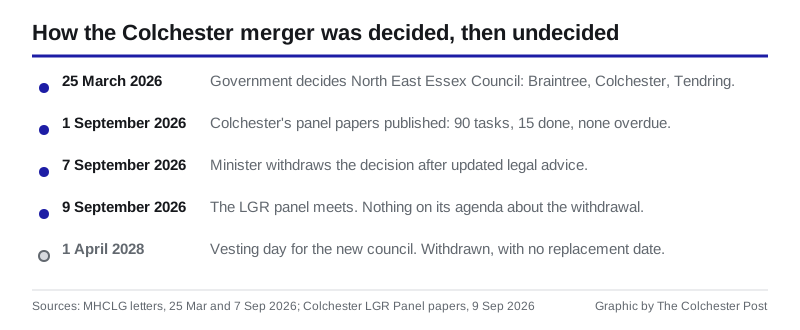
Colchester City Council is no longer due to be abolished on 1 April 2028. The government has withdrawn the decision that would have replaced it with a new North East Essex Council covering Colchester, Braintree and Tendring.
The withdrawal came in a letter of 7 September 2026 from Jim McMahon MP, Minister for Local Government, Devolution and Regional Growth. It says the Secretary of State acted “following updated legal advice (for the avoidance of doubt no privilege is waived)”. Four areas lost their decisions on the same day: Essex, Southend-on-Sea and Thurrock; Hampshire, the Isle of Wight, Portsmouth and Southampton; Norfolk; and Suffolk.
What was decided, and what has gone
The original decision was taken on 25 March 2026 by the then Secretary of State, Rt Hon Steve Reed OBE MP. His letter to Essex leaders implemented a five-council model for the county:
- North East Essex Council: Braintree, Colchester and Tendring
- West Essex Council: Epping Forest, Harlow and Uttlesford
- Mid Essex Council: Brentwood, Chelmsford and Maldon
- South West Essex Council: Basildon and Thurrock
- South East Essex Council: Castle Point, Rochford and Southend-on-Sea
Reed wrote that the model “was firmly anchored around the five key urban centres of Basildon & Thurrock, Chelmsford, Colchester, Harlow and Southend”. He also confirmed transition money: at least £900,000 for each new council, and £4.5m in total for the five Essex ones, out of £63m nationally.
Colchester welcomed it at the time. The council’s statement of 25 March called the five-council model “the option we have championed from the start” and quoted the then Leader, Councillor David King, saying residents could be assured of service “right up to the point Colchester City Council becomes part of the new unitary authority in April 2028”. The council has changed hands since. Its own register now puts the Conservatives on 18 seats under Councillor Paul Dundas, the Liberal Democrats on 12, Labour on 9, Reform on 5, the Progressive Independents Alliance on 4 and the Greens on 3.
Essex County Council takes the credit for the reversal. Its leader, Councillor Peter Harris, said in a statement the same day that “at lunchtime today we received a letter from the Government lawyers telling us that, facing a judicial review brought by Essex County Council, they have caved in”.
The panel met two days later on papers written the week before
Colchester’s LGR Transformation and Transition Panel met on Tuesday 9 September, two days after the withdrawal. Its agenda carried no item about it.
That is not a slip by the councillors. The report in front of them was converted to PDF on 1 September, six days before the minister wrote, and the figures inside it are dated 21 August. Read now, it is a record of a programme that no longer has a destination.
The progress and risk update, written by Alison Fogg for Richard Block, told the panel that the work was going well. Its appendix put the programme at 90 tasks, 15 of them completed, “with no tasks currently overdue, and the delivery status indicating that key workstreams are advancing as planned”.
It also records how far the machinery had already been built:
- a North East Essex Programme Director, Gwyn Owen, had been appointed
- workstream leads were in place across the three councils and Essex County Council, four of them from Colchester
- work had started across Greater Essex on a “service taxonomy”, a shared way of naming every service the four organisations run
The same appendix lists the top risk in each workstream. They are worth reading now that the deadline has gone:
- Finance: “Balanced budget unable to be set for 28/29”
- Legal: “Neither Shadow nor Unitary Safe and Legal as additional Insurance requirements not identified or provided for”
- Communications: “Staff anxiety and internal messaging gaps”
- Amphora, the council’s own trading company: “Loss of clarity on strategic direction and mandate during transition to North Essex Unitary”
- CIMS, the Colchester + Ipswich Museums Service: “Loss of County funding for cultural partners”
The panel’s report names no cost. It says in terms that “there are no financial implications directly linked to this report”, and the figures for the council’s asset disposal programme were taken in private under paragraph 3 of Schedule 12A to the Local Government Act 1972. So how much reorganisation has cost Colchester is not on the public record.
The council’s own website says both things
Colchester has published the withdrawal. Its LGR update page says the government “is withdrawing its current decision on Local Government Reorganisation in Essex while it considers further legal matters”, and that the council’s focus “remains firmly on delivering services for Colchester residents”.
One click away, the page headed What is the council doing now? still told readers this morning that “the new North East Essex Council is set to begin serving residents from April 2028”. The council’s budget explainer is in the same position. It says this year’s budget is “probably the last to be set by Colchester City Council that is not constrained by local government reorganisation”, and that during 2026/27 the council expects to move “to a form of joint governance with other councils in the new unitary for any substantial financial decisions”.
Neither claim now holds, and neither page had been corrected when we checked on Sunday 14 September.
What it means for you
Your council does not change. Bins, planning, car parks, council tax collection, licensing and the crematorium stay with Colchester City Council for now, and schools, social care, libraries and highways stay with Essex County Council. Our guides to bin collection days, council tax bands and planning applications are unaffected.
The May 2027 election changes shape. The March decision said plainly that “the elections that will take place for new unitary councils in 2027 will replace any existing local elections planned”. The minister’s September letter reverses that: “elections scheduled to take place in May 2027 will go ahead to existing council boundaries.” Colchester elects in thirds. The council’s own guidance says it has 51 councillors across 17 wards and elects 17 of them at a time, which is what happened on 7 May 2026, when one councillor was elected in each ward.
City status is not in question here. Colchester was one of eight places granted city status for the Platinum Jubilee, announced by the government on 20 May 2022. Neither the March decision letter nor the September withdrawal letter mentions the city title at all.
Nothing has been settled. The minister is leading a rapid review of the whole programme, including the 14 decisions taken in July, and has given no date for it. Essex now has no decision at all rather than a paused one, so a fresh proposal, a fresh consultation and a fresh decision would all have to happen before any merger date could return.
Sources
- Local government reorganisation: programme review and decisions withdrawal letter to council leaders, 7 September 2026
- Decision letter to Essex, Southend-on-Sea and Thurrock council leaders, 25 March 2026
- LGR Transformation and Transition Panel, 9 September 2026, agenda and reports
- Colchester City Council, Local Government Reorganisation Update
- Essex County Council statement, 7 September 2026
Have your say