
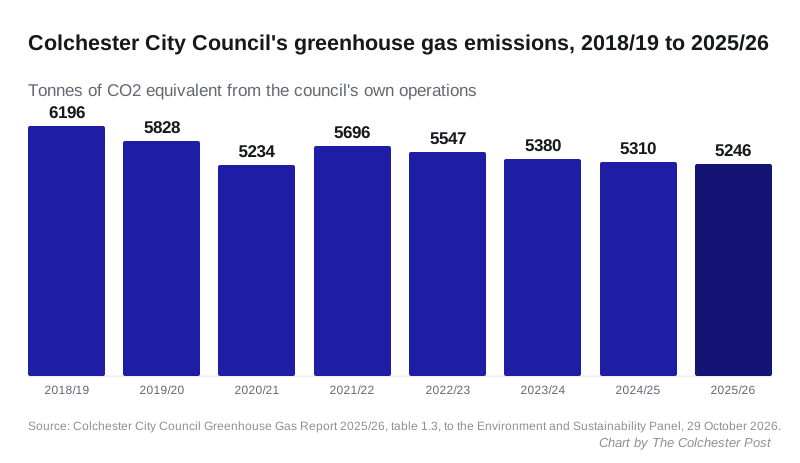
The council's emissions were 5,246 tonnes in 2025/26, about double its target line, and its report says 2030 needs major investment. Checked November 2026.
Colchester City Council is not on track to become carbon neutral by 2030, and it has not been for years. Its latest greenhouse gas report, which went to the Environment and Sustainability Panel on 29 October, says so directly. “Since the financial year 2021/22 the council is no longer on track to meet the 2030 target.”
The council’s own operations produced 5,246 tonnes of CO2 equivalent in 2025/26. The chart in the report shows a straight line falling to zero by 2030/31. For 2025/26 that line sits at about 2,600 tonnes by our reading, so actual emissions are about double where the target line says they should be.
The report’s conclusion is blunt. Even with the remaining planned work and with offsetting, “reaching the 2030 target will be challenging and would require significant investment”.
Where the emissions come from
Leisure World is the biggest single source, at about 35.2% of the total. The report calls it “by far” the council’s biggest user of energy and water. It burned 7.3 million kWh of gas in 2025/26, some of it in a turbine that makes its own electricity and heats the pools.
The largest sources by fuel were:
- natural gas: 2,385 tonnes, down 1.9%
- diesel for the bin lorries: 1,371 tonnes, up 7.7%
- grid electricity: 721 tonnes, down 19.1%
Outside Leisure World, the biggest gas users are the Crematorium, the Town Hall and the sheltered housing schemes. Rowan House and the Town Hall use the most electricity.
Why the bin lorries still run on diesel
Bin lorries account for 87.75% of the council’s transport emissions. The report says hydrotreated vegetable oil could replace diesel and save 90 to 95% of those emissions. It also says the fuel still costs more than diesel, which “prohibits the switch”.
The report’s figures do not all agree
The summary says emissions fell by 64 tonnes, or 2.5%, in a year. Those two numbers do not match.
- A 64 tonne fall from the 5,310 tonnes shown for 2024/25 in the report’s history table is 1.2%.
- The 2.5% comes from a different table, which gives 5,380 tonnes as the 2024/25 figure. The history table gives 5,380 to 2023/24.
- The report says emissions are down 16.4% on the 2018/19 baseline. Its own table figures of 6,196 and 5,246 tonnes give 15.3%.
At the average fall since 2021/22, about 112 tonnes a year, reaching zero would take more than 45 years. That is our arithmetic and not a council forecast, and it takes no account of the big projects still to come.
What is planned next
- more smart motors at Leisure World over the next year
- a possible solar farm on council-owned land
- more solar panels on council roofs and car parks, on top of the 12 buildings already fitted
- early work on cutting emissions at the Crematorium
- a proposal to make carbon literacy training compulsory for senior leaders
The council’s Climate Emergency Action Plan update says 73% of its actions are complete. The plan now runs to 2028, with almost 40 actions under eight themes.
What it means for you
The target covers only the council’s own buildings, vehicles and staff travel. It is not a target for homes or businesses in Colchester, and the count leaves out the goods and services the council buys. The report says there are no financial implications from the update itself. The cost of closing the gap would be a separate decision, and the report does not put a figure on it.
The panel only had to note the report. Its minutes, not yet published, will show what councillors made of it. We will add that when they appear.
Have your say