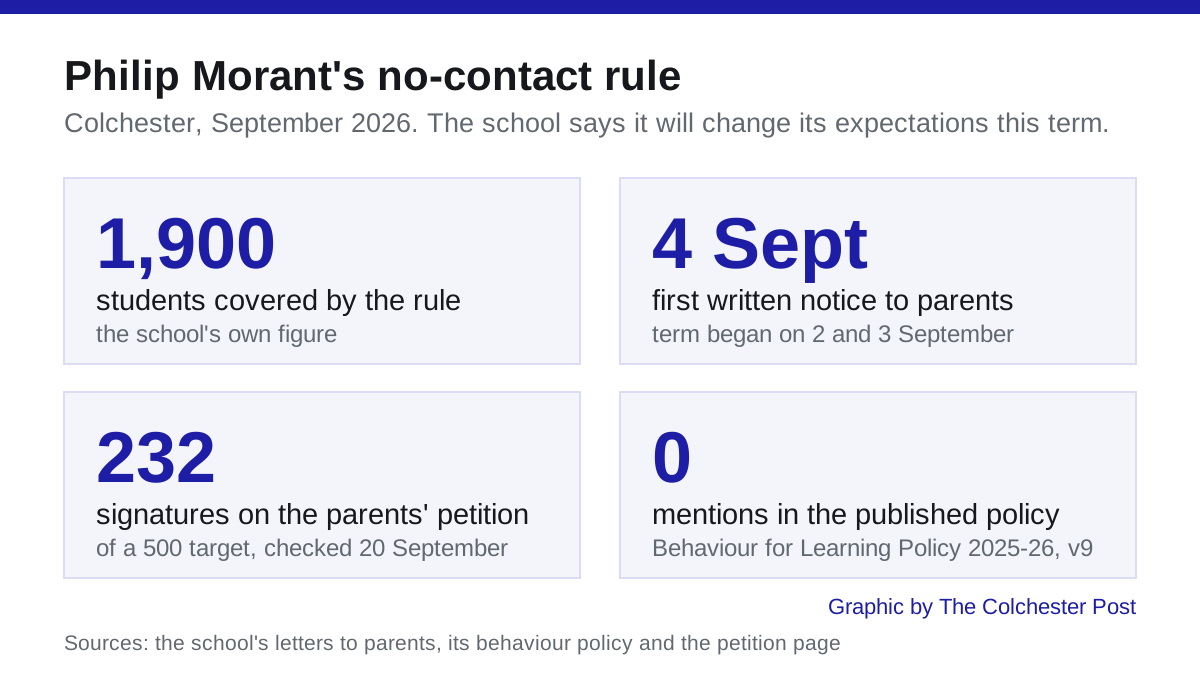

Philip Morant's published behaviour policy contains no ban on pupils touching each other. The Colchester school will change its expectations this term.
Philip Morant School and College says it will change the rule that has stopped its pupils hugging, high-fiving and linking arms since term began.
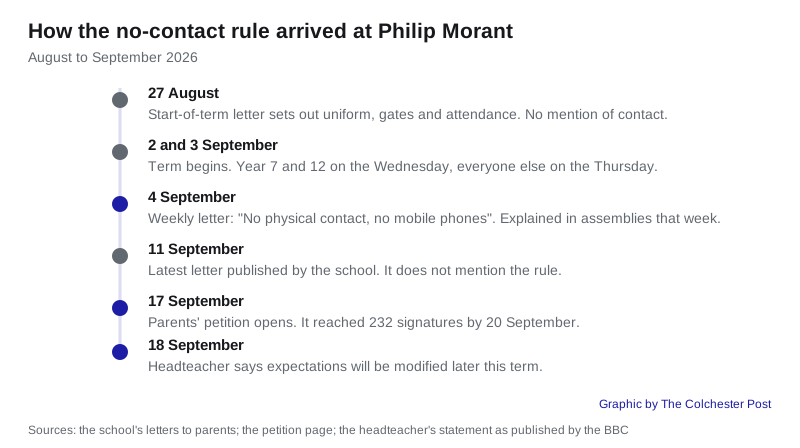
The Colchester school set out the expectation in its weekly letter to parents on 4 September, under the heading “No physical contact, no mobile phones” (Philip Morant update letter, 4 September 2026). A petition asking the school to drop it had 232 signatures on Sunday afternoon, against a target of 500 (Change.org).
The rule itself is not in the behaviour policy the school publishes on its own website.
The published policy contains no such rule
The document on the school’s Key Information and Policies page is the Behaviour for Learning Policy 2025-26. Its file properties name it “v9 - Summer term additions”. The cover page is marked DRAFT. It records its last review as April 2026 and its next review as due by Summer 2026.
We read it in full. Hugging, high fives and linking arms appear nowhere in it. What it does list, among the behaviours that can bring an internal exclusion or a suspension, is:
- physical assault on another student
- fighting or physical aggression towards a peer
- child-on-child abuse
- unwanted conduct of a sexual nature, including physical behaviour
- inappropriate sexual behaviour, including making physical contact with intimate areas
Those are the pupil-to-pupil contact rules the school publishes. They describe assault, aggression and unwanted sexual contact. They do not describe a greeting.
The policy also sets out the sanctions available to staff. They run from a C1 reminder through to a C4 removal from the lesson, and include after-school detentions of 15, 45 and 90 minutes, internal exclusion in the school’s Internal Exclusion Area, offsite isolation in another school’s isolation area, and suspension. The petition says pupils are receiving detentions and isolation for breaching the no-contact rule.
The one “no contact” line in the policy is about staff
The phrase “no contact” does appear in the policy once. It is a quotation from Department for Education guidance, and it warns schools off such policies:
“The adoption of a ‘no contact’ policy at a school can leave staff unable to intervene where reasonable in the circumstances to fully protect pupils. School leaders should adopt sensible policies which allow and support their staff to make appropriate physical contact”
That passage is worth quoting accurately, because it is easy to misread. It sits in the section on reasonable force, and it is about whether staff may touch pupils, not about whether pupils may touch each other. It is not a ruling on the rule now under review. It is a reminder that the school’s own published policy already treats a blanket ban on contact as something to be careful with.
The same policy lists four reasons staff will have cause to touch a pupil: to comfort a child in distress, to direct them, for curricular reasons such as PE, music and drama, and in an emergency to avert danger.
What the school told parents, and when
The rule was not flagged to families before term. The school’s start-of-term letter of 27 August runs to several pages and covers attendance targets, gate arrangements year by year, drop-off restrictions on Landseer Road, Rembrandt Way and Reynolds Avenue, skirt length, nails, piercings and lanyards (Philip Morant letter, 27 August 2026). It does not mention physical contact. Neither does the 21 August letter, nor the 1 September letter sent the day before Year 7 returned.
Year 7 and Year 12 started back on Wednesday 2 September. Everyone else returned on Thursday 3 September. The 4 September letter told parents the expectation had been “explained to students in assemblies this week”, that it would feature in the information evening presentations, and that the slides were in their child’s Google Classroom. The slides are not public.
So the first written notice to parents came after the rule was already in force.
The school’s most recent published letter, dated 11 September, does not mention the rule or the review. As of Sunday afternoon no letter dated 18 September had appeared on the school’s Letters Home page, and the school has published nothing about the review on its own website.
What the petition asks for
The petition was started on 17 September by parent Jen Summers. It does not ask for the rule to be scrapped without replacement:
“We fully support the school taking firm action against fighting, bullying, unwanted touching and unsafe or inappropriate behaviour. Our concern is that the current rule prohibits all physical contact between pupils, including normal interactions between friends such as hugging, linking arms, high fives or comforting somebody who is upset.”
It gives two reasons. The first is about consent: “A blanket ban risks sending the message that all physical contact is inappropriate and punishable, rather than teaching children the difference.” The second is about wellbeing.
It also quotes the school’s own Home/School Agreement, which sits at Appendix A of the behaviour policy. The version published on the website asks parents to undertake “to engage with the school in developing action plans designed to support my child’s social, emotional and well-being needs if appropriate”. The petition’s closing line is that this is exactly what the parents signing it are trying to do.
What the school has said
The school has not issued a statement on its own website. In a statement given to the BBC and published on 18 September, headteacher Stephanie Neill said the rule followed “an increase in overly physical behaviour last term that disrupted learning and raised safety concerns” (BBC News, 18 September 2026).
She said: “Our top priority is ensuring our 1,900 students feel safe and comfortable moving around our school site.”
On the review, she said: “We are currently working with our student leaders to define appropriate, consensual guidelines that reflect a focused learning environment and student wellbeing.” The school said students had responded “brilliantly” to the new rules but that pupils “want positive ways to greet and engage with their friends”, and that behaviour expectations would be modified later this term.
The school has not published any figures for the increase in physical behaviour it cites, and no such figures appear in its letters to parents or in any document on its website.
The 1,900 pupils this covers
Philip Morant is one of the largest schools in Essex. The Department for Education’s register records 1,888 pupils on roll against a capacity of 1,902, an 11 to 18 academy on Rembrandt Way in Prettygate, part of The Sigma Trust (Get Information About Schools, URN 146794). The trust runs twelve schools, seven of them in the Colchester area, including St Helena, The Stanway School, Paxman Academy and Thomas Lord Audley (Ofsted).
Ofsted last inspected the school on 13 and 14 September 2023 and rated it Good in every area, including behaviour and attitudes. Inspectors wrote that “school is a calm and orderly place”, that pupils respect staff, and that “suspensions have significantly reduced” (Ofsted inspection report, published 20 October 2023).
The same report notes: “Specialist staff effectively support those pupils with visual impairment and those who are deaf.” That matters to the review the school has promised. Government guidance says a behaviour policy should be “inclusive: consider the needs of all pupils and staff, so all members of the school community can feel safe and that they belong”, and “accessible and easily understood: clear and easily understood by pupils, staff and parents” (Behaviour in schools: advice for headteachers and school staff, DfE, February 2024). For a pupil who cannot hear someone approach, a tap on the arm is not a greeting. It is how you start a conversation.
What it means for you
Read the policy your child is being sanctioned under. It is the Behaviour for Learning Policy on the school’s Key Information and Policies page, under Behaviour, Attendance and Welfare. Because Philip Morant is an academy rather than a maintained school, the DfE position is that it “should publish details of the school’s behaviour policy”, not that it must publish the policy itself. A rule can therefore be enforced before the published document catches up. That is what has happened here, and it is why the version on the website is the place to check what has changed when the revision lands.
Expect a change this term, not immediately. The school has said it is working with student leaders and will modify its expectations later this term. It has not given a date.
If you want to raise it formally, there is a published route. The Sigma Complaints Policy, version 9 of May 2026, sets out five stages. Stage one is an informal concern to a member of staff, which can be raised in person, by telephone or in writing, and which should be discussed within 15 school days. Stage two is a formal complaint to the headteacher, also within 15 school days. If the complaint is about the headteacher, it goes in writing to the chair of the Local Governance Committee.
A detention can be challenged on its own terms. The behaviour policy says parental consent is not required for detentions, but it also says all sanctions “will be proportionate and reasonable and will take into consideration the student’s age, and any special educational needs or disability”, and that staff should consult the SENCO where a student has special educational needs.
We cover Colchester schools from the record rather than the rumour. Our last schools story was the Colchester A level results for 2026.
Sources
- Philip Morant School and College, update letter to parents, 4 September 2026
- Philip Morant School and College, letters to parents, 21 August, 27 August, 1 September and 11 September 2026
- Philip Morant School and College, Behaviour for Learning Policy 2025-26, version 9
- Sigma Complaints Policy, version 9, May 2026
- Petition: Ask Philip Morant School to Reconsider the Blanket No-Contact Policy, signature count checked 20 September 2026
- Get Information About Schools, Philip Morant School and College, URN 146794
- Ofsted inspection report, Philip Morant School and College, 13 and 14 September 2023
- Behaviour in schools: advice for headteachers and school staff, Department for Education, February 2024
- Headteacher’s statement as published by BBC News, 18 September 2026
Have your say