
Colchester has fined Peabody £13,600 and Anchor £10,000 over rented homes. A tribunal also backed its fire safety notice on a New Town house, 11 months after the landlord appealed.
Colchester City Council has issued £23,600 of civil penalties against two of the country’s largest housing associations over rented homes in the New Town and Christ Church area of the city. It has also had a fire safety improvement notice on a house in multiple occupation confirmed by a tribunal, almost a year after the landlord appealed against it.
The council set out all three cases in a statement on 18 September. It did not link to the tribunal’s decision. That decision has been published in full on GOV.UK, and it is the more useful document of the two, because it sets out the test the council and the tribunal used to decide what kind of house it was.
The two penalties
The council’s private sector housing team issued civil penalty notices to two providers:
- Anchor Housing, £10,000, issued on 12 June 2026, for partly failing to comply with an improvement notice requiring drainage works at a rented property.
- Peabody Housing Association, £13,600, issued on 24 July 2026, for failing to provide an Electrical Installation Condition Report when the council asked for one.
Both are large national landlords rather than small private ones. The electrical report is the more straightforward failure. Under the Electrical Safety Standards in the Private Rented Sector (England) Regulations 2020, a landlord must have the electrical installation inspected and tested by a qualified person at least every five years, give the tenant a copy of the report, and supply a copy to the council within seven days of being asked. Without it, the council says, it could not confirm the installation had been tested at all.
The ceiling on both penalties is the same. A financial penalty under the 2020 regulations must not exceed £40,000, and the same cap applies under section 249A of the Housing Act 2004, which covers the improvement notice failure. That figure is new. It was £30,000 until 1 May 2026, when regulations made this year raised it. Both Colchester penalties were issued after the rise, and both sit well below the new maximum.
Either provider can appeal. Under Schedule 13A of the Housing Act 2004, a landlord given a final notice may appeal to the First-tier Tribunal against the decision to fine or against the amount, and the notice is suspended until that appeal is determined or withdrawn. The council’s statement does not say whether either penalty has been appealed or paid, and neither Anchor nor Peabody has published a response.
The HMO case: 17 months from inspection to a confirmed notice
The third case is the one with a public record behind it. The tribunal’s decision, reference CAM/22UG/HIN/2025/0019, concerns a three-storey mid-terrace house in George Williams Way and was decided on 22 July 2026 by Judge Bernadette MacQueen and Regional Surveyor Mary Hardman. We are not naming the landlord, who is a private individual.
The sequence matters, because it explains why a fire safety problem identified in early 2025 was still unresolved this summer.
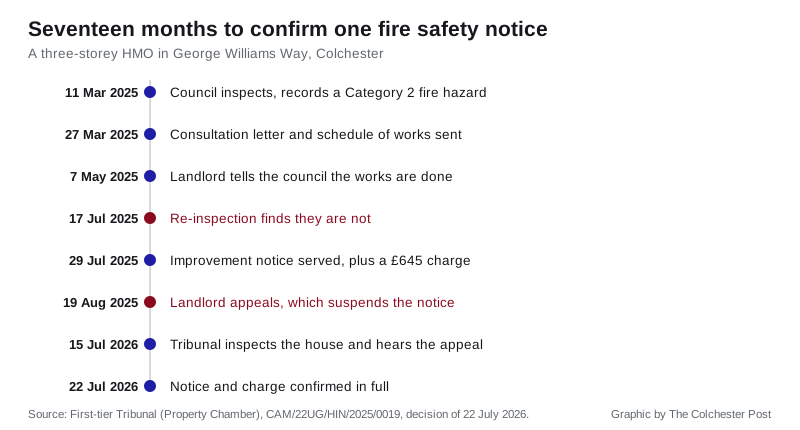
A council environmental health officer, Daniel Ward, inspected the house on 11 March 2025 and assessed it under the Housing Health and Safety Rating System. He recorded a Band E Category 2 fire hazard. A consultation letter with a schedule of works followed on 27 March 2025, giving 28 days for representations and warning that a £645 administrative charge might be imposed.
On 7 May 2025 the landlord told the council all the required works had been done. The officer re-inspected on 17 July 2025 and found they had not. The improvement notice was served on 29 July 2025. It required a fire blanket within seven days, work on the fire doors and the understairs cupboard door within 60 days, and a Grade A LD2 fire detection and alarm system within 90 days.
The landlord appealed on 19 August 2025, within the 21-day limit. That appeal suspended the notice’s operative date until the case was finally determined. The hearing and inspection took place on 15 July 2026, at the property and then at the Holiday Inn in Colchester, and the decision followed a week later. For eleven months, the works the council said were needed were not legally due.
Bedsit HMO or shared house: the test the tribunal used
The whole appeal turned on one question. The landlord argued the house was a shared house let to four people on a single joint and several assured shorthold tenancy, not a bedsit-type HMO, and that the council had therefore applied the wrong fire safety standard and demanded works that were not needed.
The tribunal disagreed, and its reasons are worth reading if you rent a room in Colchester or let one. It found the house was a bedsit-type HMO because:
- locks were fitted to the bedroom doors, so occupiers did not have exclusive possession of the whole house
- individual rooms had been advertised, which the landlord accepted at the hearing
- one occupier had found the room through SpareRoom.co.uk and did not know the others before moving in
- the occupiers had no control over who replaced a departing tenant
- the tenancy agreement relied on named four people, but by the time the notice was served only three of them still lived there, and the replacement was not a party to it
- not all the named tenants had signed the agreement
On the alarm, the tribunal accepted that the existing Grade D interlinked system was inadequate for a bedsit-type HMO over three storeys, and that LACORS fire safety guidance supports a Grade A system with a control panel, which identifies where an alarm has gone off. The landlord said a competent person had advised the existing system was enough, but produced no statement or report from that person.
The notice was confirmed in full, and so was the £645 charge for serving it. The works must now start within 28 days of the decision, with the alarm installed within 90 days of that start date. The tribunal noted the fire blanket appeared to have been fitted, subject to the council checking.
What it means for you
If you rent in Colchester, three practical things come out of this.
- You can ask your landlord for the electrical report. An Electrical Installation Condition Report is required at least every five years, and you are entitled to a copy. If you cannot get one, the council’s private sector housing team can ask for it, and failing to supply it within seven days is what cost Peabody £13,600.
- A locked bedroom door changes what the fire rules require. If rooms in a house are let and advertised separately, the house is likely to be a bedsit-type HMO whatever the tenancy agreement says, and that triggers a higher fire safety standard, including a mains-wired alarm system with a control panel.
- Reporting a problem does not mean a fast fix. This case ran 17 months from the first inspection to a confirmed notice, and an appeal legally paused the deadline for most of it.
The council asks private renters with concerns about conditions to contact its private sector housing team. Council tax bands for rented properties are on our Colchester council tax bands page, and planning applications, including HMO conversions, are on our Colchester planning news page.
Sources
- 98 George Williams Way, Colchester CO1 2JZ, CAM/22UG/HIN/2025/0019, First-tier Tribunal (Property Chamber), decision of 22 July 2026, for the full chronology, the HHSRS assessment, the bedsit-versus-shared-house findings, the Grade A LD2 requirement, the compliance periods and the £645 charge.
- Council takes action to help keep rented homes safe, Colchester City Council, 18 September 2026, for the two civil penalties, their amounts and dates, and the ward.
- Regulation 11, Electrical Safety Standards in the Private Rented Sector (England) Regulations 2020 for the penalty cap, and section 249A of the Housing Act 2004 for the £40,000 maximum, substituted on 1 May 2026 by SI 2026/319.
- Schedule 13A, Housing Act 2004, paragraph 10, for the right of appeal against a civil penalty and the suspension of the final notice.
Have your say