
Colchester's final Local Plan consultation closes 4pm on 13 October, allocating 12,208 homes: 2,500 at Marks Tey, 2,000 in north-east Colchester.
Colchester City Council has opened the last consultation on its new Local Plan, and it closes at 4pm on Tuesday 13 October 2026. (Engagement and consultation, Colchester City Council)
This is the stage that counts. After it closes, the plan and every comment go to the Secretary of State for examination by a government planning inspector. The council’s own page is explicit about what that means for residents: “If you wish to participate in the Independent Examination, you need to submit a representation to this consultation.”
The number: 21,692 homes by 2043
Policy ST5 of the Submission Draft Local Plan commits the council to plan for at least 21,692 new homes in Colchester between 2026 and 2043. That is an annual requirement of 1,276 homes a year, produced by the government’s standard method for calculating housing need.
The council is clear that it did not pick the figure. The plan states that under the National Planning Policy Framework of December 2024, “this is a mandatory target which must be planned for”.
For context, Colchester delivered 924 new homes in the year to March 2026, and has averaged 928 a year since 2001/02.
Where the 21,692 comes from
The plan does not allocate sites for all of it. Table ST5.1 breaks the supply down as follows, measured at 31 March 2026:
- existing commitments, meaning sites that already have planning permission: 5,488
- the Tendring Colchester Borders Garden Community, Colchester’s share to 2043: 1,875
- a windfall allowance, for sites that are not allocated: 2,985
- new Local Plan allocations: 12,208
That totals 22,556 homes, which is 864 more than the requirement. The plan explains the gap at paragraph 3.45: the standard method figure has moved between 1,276 and 1,300 during drafting, so the council has built in “a prudent allowance for future variations”.
The ten biggest sites
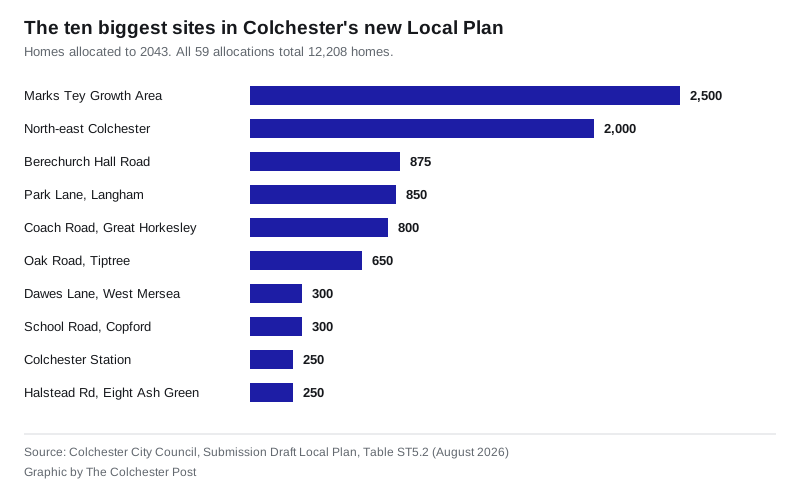
The 12,208 new allocations are spread across 59 sites in Table ST5.2. Ten of them account for 8,775 homes, or about seven in every ten:
| Site | Homes | Policy |
|---|---|---|
| Marks Tey Growth Area | 2,500 | OA5 |
| North-east Colchester | 2,000 | PP9 |
| Land south of Berechurch Hall Road | 875 | PP10 |
| Land north of Park Lane, Langham | 850 | PP37 |
| Land north of Coach Road, Great Horkesley | 800 | PP34 |
| Land north of Oak Road, Tiptree | 650 | PP19 |
| Land east of Dawes Lane, West Mersea | 300 | PP23 |
| Land east of School Road, Copford | 300 | PP29a |
| Land at Colchester Station | 250 | PP6 |
| Land north of Halstead Road, Eight Ash Green | 250 | PP32 |
Two more sites of 250 and 200 sit just below: land south of Halstead Road at Eight Ash Green, and land west of Station Road at Wakes Colne. Wivenhoe’s allocation is 200 homes north-west of the fire station, under PP24.
Marks Tey is back, in a different shape
In 2025 the council withdrew its interest in a new town at Marks Tey, saying it was not viable without major infrastructure investment. Policy OA5 now returns to the village with a smaller, differently framed proposal: a “Growth Area” of about 2,500 homes within the plan period, described as part of an expected larger development beyond 2043.
Alongside the homes, OA5 requires:
- approximately 18 hectares of employment land in the plan period, of an expected 40 hectares eventually
- land for a new secondary school south of the A120, on a 12.4 hectare parcel
- two primary school sites of 2.2 hectares each, one north and one south of the A12 and A120
- at least 49 hectares of Suitable Alternative Natural Greenspace, and three new parks
- a Marks Tey to Copford Strategic Green Gap on the south-eastern edge, to stop the two settlements merging
- safeguarding of the route of the A12 widening scheme, in line with the approved Development Consent Order
There is a brake built in. Part C of the policy says planning applications for major housing and employment “will not be supported” until a masterplan has been adopted as a Supplementary Plan.
North-east Colchester keeps the gap open
Policy PP9 allocates about 2,000 homes on the city’s north-eastern edge, and requires open space “substantively in excess of 10%” of the site. The stated purpose is to “maximise the width of the undeveloped corridor between Colchester and the proposed Garden Community”.
It also sets a minimum 50 metre buffer to Bullock Wood, an ancient woodland and Site of Special Scientific Interest, with the final extent to be agreed with Natural England. A two form entry primary school with early years provision is required on a 2.2 hectare parcel, along with additional clinical capacity at Highwoods GP or elsewhere nearby.
A discrepancy worth knowing about
The supporting text and the policy table do not quite agree. Paragraph 3.36 says committed sites “are forecast to deliver 5,588 new homes in the plan period”. Table ST5.1 records existing commitments as 5,488, and the table’s own total of 22,556 only adds up using 5,488.
It is a hundred homes, and it does not change the headline. But this is the version going to a planning inspector, and this consultation is specifically about whether the plan is “justified, effective and supported by evidence”. It is the kind of thing a representation can raise.
What the councillors said
Councillor Martin Parsons, chair of the Local Plan Committee, was blunt about the choice in front of the committee.
“Councillors on the local plan committee faced the profoundly uncomfortable choice between a plan, which allocates sites for the thousands of houses the government requires the council to identify, despite strong objections from residents, or having no plan,” he said.
“Having no plan would effectively hand over control to developers who would be able to apply to build even larger housing estates anywhere.”
Councillor Paul Dundas, leader of the council, said the targets “are driven by national policy and are not numbers the council has chosen itself”, and that without an up to date plan the council would have “less influence over where development takes place, reduced ability to secure infrastructure alongside growth and greater exposure to speculative development proposals”. (Council news release, 28 August 2026)
What it means for you
If a site near you is in that table, this is your last chance to say something before an inspector, not a councillor, decides.
The rules have changed since the last round. In December 2025 the council asked for views on options. This time, representations should address whether the plan is legally compliant and “sound”, meaning positively prepared, justified, effective and consistent with national policy. Saying you do not want the homes is not, on its own, one of those tests. Saying the evidence does not support the site, or the infrastructure will not arrive with it, is.
To take part:
- Online: the council’s consultation portal lets you comment policy by policy, upload documents and track your submission. The council says it “strongly encourages” this route.
- On paper: at Colchester Town Hall, 9am to 5pm Monday to Friday, and at Colchester, Greenstead, Prettygate, Stanway, Tiptree, West Mersea and Wivenhoe libraries.
- Problems with the portal: local.plan@colchester.gov.uk
- Deadline: 4pm on Tuesday 13 October 2026. Every representation received is published on the council’s website and sent to the Secretary of State.
Once adopted, this plan is the document your neighbours’ extensions and the housebuilders’ applications will be judged against. We track individual decisions on our Colchester planning news page. If you are weighing up what the allocations might do to values near you, our Colchester house prices page carries the latest Land Registry figures for the district.
Have your say